

WoW Forever Is Bringing Back Something Modern WoW Lost
Ask around any Classic or Retail community and you'll hear a version of the same complaint: the open world used to feel alive, and now it mostly doesn't. Not because the zones got worse. Because over twenty years, a long list of individually reasonable features quietly removed almost every reason to talk to a stranger while questing. Dungeon queues got shorter. Mob competition got easier. Flying got you where you were going faster. Each change solved a real problem. Together, they solved the open world right out of the game.
World of Warcraft: Forever, launching November 4, 2026, is making a deliberate bet that this was a mistake. It's not adding a social feature. It's removing several convenience features that Retail added over the years, specifically because those conveniences are what hollowed the world out in the first place. That's a real design position, it's already controversial in the beta, and it's worth understanding before you decide which version of the game you want to play.
| No Dungeon Finder Classic-style LFG tool only. No auto-match, no teleport. |
No shared tagging First hit gets credit. Grouping is the only way to share it. |
| Recent Allies Players you've grouped with are marked next time you see them. |
Realmless rulesets One large shared population per ruleset, not dozens of dead realms. |
What Actually Emptied the Open World
It wasn't one system. It was several stacking on top of each other over multiple expansions, and each one solved a real problem while quietly removing a reason to talk to anyone:
- The Dungeon Finder let you queue from anywhere and get teleported straight to a group of strangers, so you stopped needing to travel, recruit in chat, or rely on your guild.
- Shared mob tagging meant you no longer had a reason to invite the other player fighting the same wolf, since you'd both get credit anyway.
- Flying let you skip most of a zone instead of riding through it.
- Cross-realm tech and phasing meant the player standing next to you might not even be able to see you, depending on your quest progress or which layer you'd been placed on.
None of these were bad ideas in isolation. Queue times were a real problem. Mob competition in crowded zones was genuinely annoying. But the cumulative effect, over years, was an open world you could complete from start to finish without ever needing another player for anything that wasn't a hard requirement.
No Dungeon Finder, No Auto-Summon
Forever's answer starts here. There's no automated Group Finder and no Dungeon Finder in the modern sense, confirmed directly by Lead Designer Tim Jones and Lead Encounter Designer Mike Nuthals. What exists instead is the Classic-era Looking For Group tool: a list where you post what you're running and what role you need, and other players browse it and message you. It organizes people. It does not match them, and it does not teleport anyone anywhere.
Meeting Stones don't summon players either. The only way to pull someone to an instance is the Warlock's Ritual of Summoning, and even that requires two other party members physically present at the destination to help. Getting a five-person group into a dungeon means someone has to actually travel there first, the same way it worked in 2005.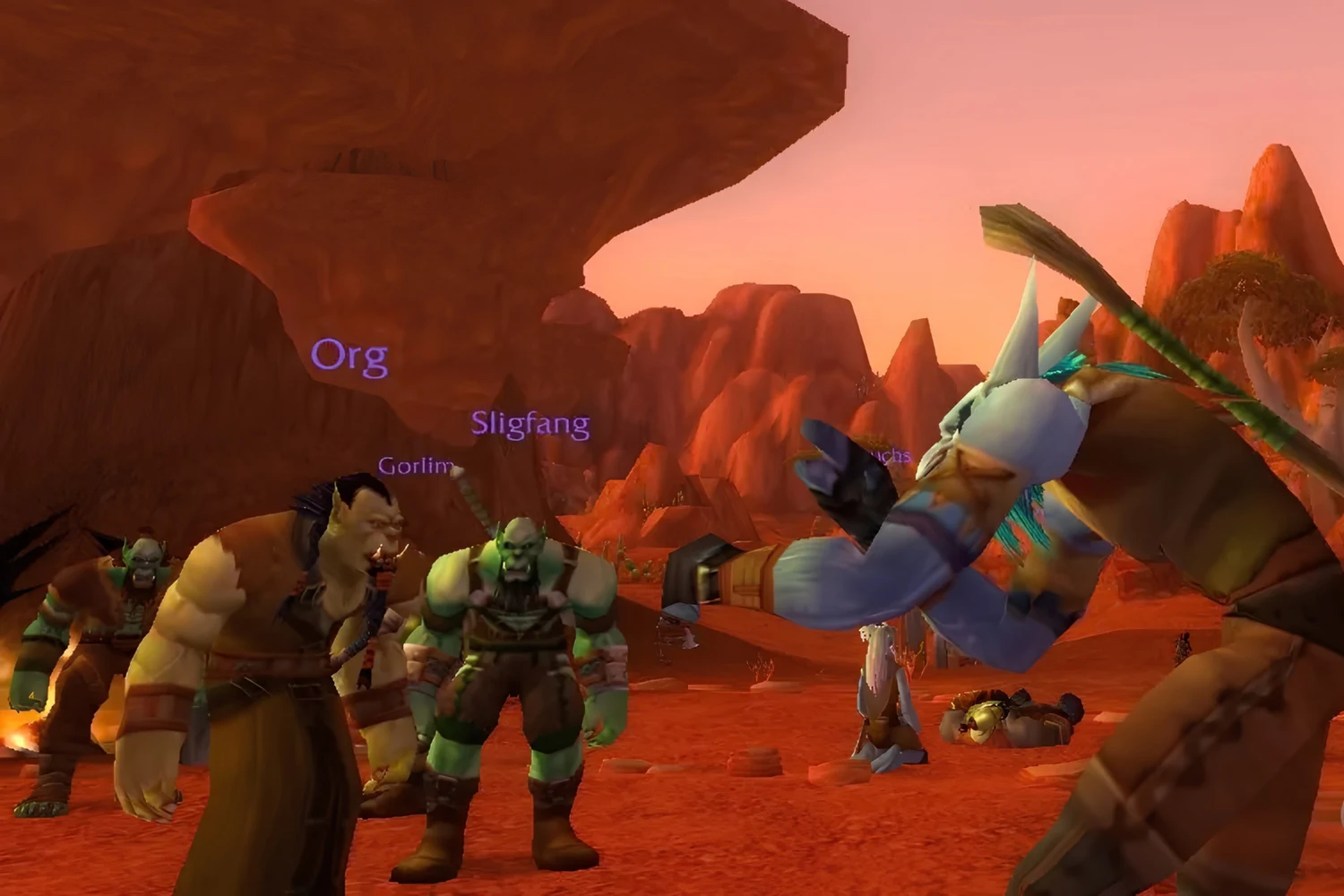
Blizzard Is Holding the Line on Mob Tagging, Even Though It's Causing Real Problems Right Now
This is the clearest evidence that Forever's social design is intentional rather than incidental, because it's the one piece Blizzard has publicly defended under pressure. Retail WoW has used some form of shared tagging for years: hit a mob that someone else is already fighting, and you both get full credit even if you're not grouped. Forever doesn't have it. Credit goes to whoever tags the mob first, or to their party.
A Blizzard developer, Josh Greenfield, has said directly that the team intends to hold that line, because removing the friction would also remove one of the last remaining reasons to invite a nearby stranger into your group. That's the whole mechanic in a sentence: you don't get credit unless you're grouped, so if you want the credit, you ask.
It's a genuinely uncomfortable trade-off, and beta testing has already shown both sides of it. Crowded starting zones have turned simple kill quests into races between dozens of players going for the same handful of spawns.
PC Gamer wrote about a specific case: a quest in Orgrimmar called Rocks to Rest needs eight of a single gathering item. With ten players camping the same sporadic spawns, picking one up became a literal sprint every time it appeared. Gathering nodes and quest objects are server-side in Forever, so once someone loots one, it's gone for everyone until it respawns. There's no shared version of that the way there sometimes is in Retail.
The workaround is the same one Classic veterans already know: invite the people standing around you. It costs a few seconds, it works, and it's exactly the kind of small, forced interaction that stopped happening once shared tagging made it unnecessary. Whether that trade is worth the launch-week chaos is a genuinely open question, and it's one Blizzard is answering with "yes, on purpose" rather than walking it back.
Recent Allies: Turning a Stranger Into a Familiar Face
Tagging friction only works as a social system if the game gives it somewhere to go, and this is the part that's easy to miss if you only look at the tagging complaints. Forever pairs the tagging rules with a feature called Recent Allies, which marks the names of players you've recently grouped or fought alongside with a different color the next time you run into them.
Greenfield described the intended arc when defending the tagging decision: the first time you group with a stranger for a kill quest, you probably don't say much. The next day, questing in a different zone, you spot that same colored name and recognize them from yesterday. The friction of inviting them again drops a little. Maybe this time you actually talk. Repeat that a few times, and you've got something closer to a real acquaintance than a one-off group invite.
That's the mechanism the tagging system is actually built to feed. Without some way to recognize a repeat face, forced grouping is just forced grouping. Recent Allies is what's supposed to turn it into something that compounds.
Camping: A System That Only Works If Other Players Show Up
The Camping system gets mentioned constantly in Forever coverage, but it's worth being specific about why it belongs in this piece rather than in a separate feature list: it's built so that it barely functions with just you.
Any player can drop a campfire. From there, players with a profession can place a crafted object at it, up to three per fire, and everyone who sits down gets the resulting buff, not just whoever built it. A Blacksmith's object might add Strength, a Tailor's might add Spirit, a Herbalist's might add Intellect. No single character has every profession, so a campfire with all three slots filled almost always means at least two different players contributed something to it.
Greenfield has talked about this firsthand rather than just as a design goal, describing repeated moments at a campfire chatting with other players, trading items, or pointing someone toward a quest objective, and calling it more effective in practice than he expected. That's the same throughline as tagging and Recent Allies: none of these systems is meant to work in isolation. A campfire gives you a reason to stop moving in the same spot as other players; tagging gives you a reason to invite the ones nearby; Recent Allies gives you a reason to remember them next time.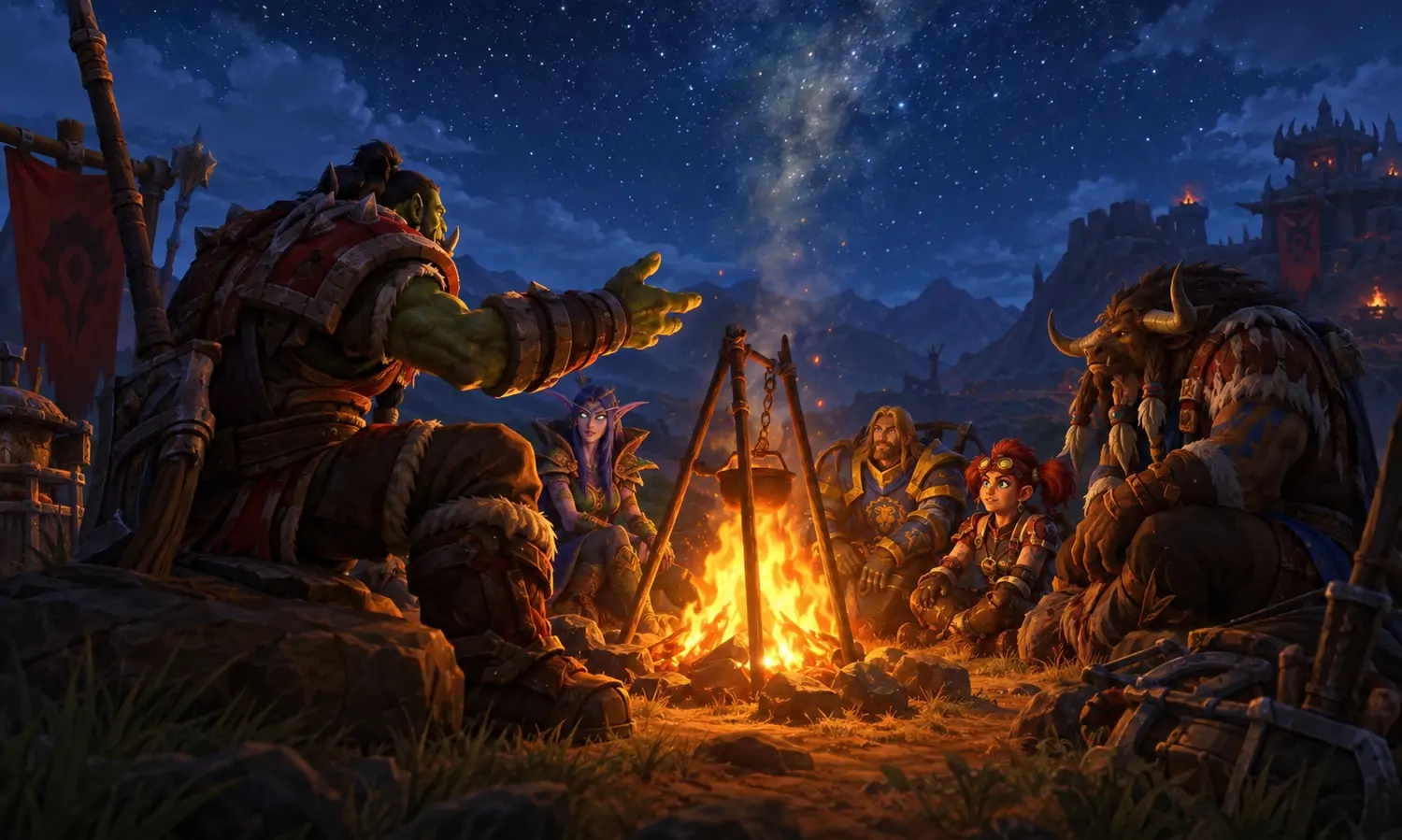
Realmless Doesn't Mean Empty
Forever also drops the traditional realm list. Instead you pick a ruleset at character creation, Normal, PvP or Roleplaying at launch, with Hardcore following later, and that ruleset functions like one large shared population instead of dozens of separate servers that inevitably end up with a few crowded ones and many dead ones. You can only group with players on your own ruleset and faction, but within that ruleset the population is deliberately much larger than an individual Classic server ever was.
Combine that with no flying and no level scaling, and you get zones you actually have to ride through rather than skip over, populated by more people than an old-style realm could put in front of you at once.
The Honest Caveat: Layering Hasn't Fully Gone Away
None of this means Forever has solved population management cleanly. Handling a large concurrent player base still requires some form of the layering technology Classic used at its 2019 launch, and beta feedback threads already include complaints that this system fragments the sense of a shared world, with reports of quest progress being disrupted when a layer switches mid-session. That's a direct tension with the game's own social pitch, and it's not clear yet how much it'll matter once launch week's population crush settles down. Genuinely unresolved, not spin.
Worth noting too: none of this required inventing anything new on top of Classic's existing conventions. Mages still hand out free food and water to strangers in cities. Warlocks summoning a group still means someone has to be there to help. Paladins and Druids still throw a buff on a random nearby stranger before a pull. Forever isn't adding those habits back, it's just not building anything that makes them optional the way Retail eventually did.
Will Bringing Back the Mechanics Bring Back the Culture?
This is the real question, and it's bigger than any patch note. A lot of what people remember fondly about old Azeroth wasn't the tagging rules or the lack of a Dungeon Finder. It was the community norms those systems forced into existence: people helping a stranger with a group quest, guilds that felt like small towns, the low-grade obligation to be decent to the people you kept running into.
Removing the modern conveniences brings back the conditions that used to produce that behavior. It doesn't guarantee the behavior comes back with it.
The Rocks to Rest chaos is a fair preview of both possibilities at once: some players are inviting strangers and moving on, and some are just racing each other for a rock. Which of those becomes the norm probably depends less on the systems Blizzard ships and more on who shows up, and how they choose to play, once the launch-week crush eases off.
If you've been holding off on WoW because the open world stopped feeling like a place, Forever is the most direct attempt in years to give that back to you. Whether it delivers is something only a live, populated server can actually answer.
Getting a character through the early levels, where zone population is highest and the grouping friction is most noticeable, is also where a WoW Forever Power Leveling service can help if your time is limited.
There are no approved comments yet. Be the first to leave one.